ServiceNow Vault: Quiet Guardian of Sensitive Data
If you have worked on ServiceNow for long enough, you most probably will have faced this uncomfortable question at least once:
“Where do we safely store passwords, API keys, credentials?”
In the early days, a lot of teams didn’t really give it a lot of thought: credentials stored in plain text fields, system properties, or hidden variables. It worked—until it didn’t. Audits failed, security teams raised concerns, and suddenly everybody realized that convenience had quietly replaced good security practices.
This is where ServiceNow Vault fills the gap.
Not flashy, does nothing to change the way forms look, and is seldom mentioned in beginning tutorials, but it is very important to enterprise security. Vault is more than a feature; it’s a different mindset.
What Is ServiceNow Vault, Really?
ServiceNow Vault is a safe storage facility purposely built for storing sensitive information, which includes:
- Passwords
- API tokens
- Credentials for integrations
- Encryption keys
- Secrets utilized by MID Servers
Unlike regular fields or system properties, data stored in Vault is encrypted, isolated, and authorized. Even system administrators cannot casually access Vault secrets to review them like other configuration information.
In other words, Vault is like a locked room in your ServiceNow system—a locked room where only approved processes can enter, and even then, they do not see everything.
Why Vault Exists (And Why It Matters)
As the features of ServiceNow grew from a ticketing system to an end-to-end enterprise platform, the number of integrations went through an explosion. Today, instances interact with:
- Cloud providers
- HR systems
- Human IFTTT
- External APIs
- On-premise infrastructure through MID Server skills.enduser
All these relationships demand authentication.
Such information stored in an insecure manner poses the risk of:
- Accidental exposure
- Insider threats
- Failed audits
- Non-compliance
The problem that Vault addresses is that of separating secrets from logic. Now your scripts, integrations, and workflows can utilize credentials without uttering them. Simultaneously, this separation significantly improves their security posture.
How Vault Works Behind the Scenes
One of the things that makes Vault appear invisible is that it operates in the background.
If the secret is kept in Vault:
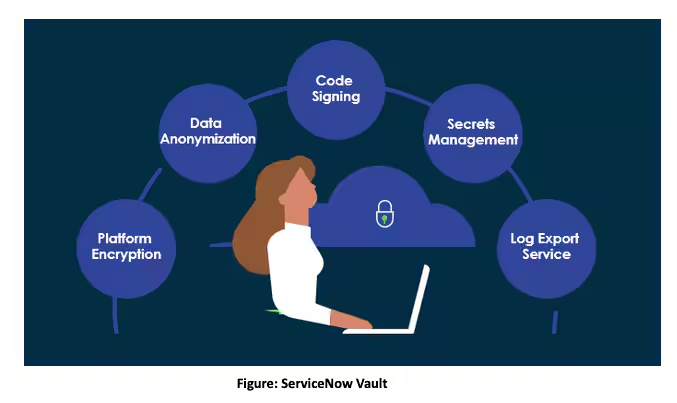
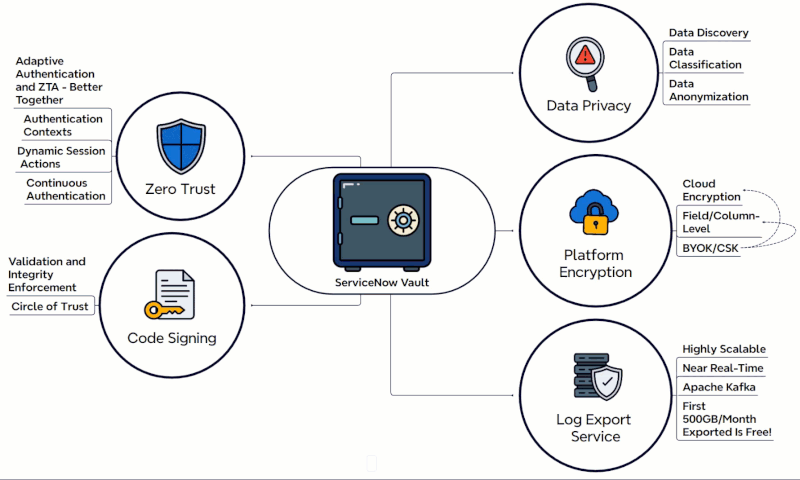
- It is encrypted using platform-level encryption
- It is not returned as plaintext
- It is accessed through secure references
- It honors strict role restrictions
Instead of embedding the password in the Script Include or REST message, you reference the Vault entry instead. ServiceNow looks it up safely only at run time, and only for that particular operation.
- No logging
- No display values
- No accidental leaks
Vault Compared with Traditional Storage Techniques
Many teams wonder why they cannot simply use system properties or encrypt the value. These alternatives may look sufficiently secure on paper, but do not work in practice.
- System properties might be accessible for admins
- Encrypted values can be revealed in scripts or exported
- Puzzlements — a security nightmare
Vault, on the other hand:
- Prevents direct visibility
- Restricts access even to admins
- Connects seamlessly with credentials management
- Offers support for enterprise compliance requirements
It’s the difference between locking a drawer and putting in place a proper safe.
Where Vault Is Commonly Used
Vault is quietly providing functionality for many aspects of the platform, mostly without the awareness of users.
Common examples include:
- Outbound REST integrations
- OAuth token storage
- MID Server secrets
- Cloud discovery authentication
- Third-party API keys
- Encryption secrets
Each time you spot a configuration mentioning a “secret” without displaying its value, there is a strong possibility of Vault at work.
A Pragmatic Example
Suppose that you are attempting to merge the ServiceNow system with an external monitoring solution.
You require:
- An API endpoint
- A username
- A secret token: Merlin
Without Vault, that token may end up being:
- Hardcoded in a script
- Stored in a property
- Copied across environments
With Vault:
- The token is stored just once, securely
- Scripts refer to it indirectly
- Cloned instances don’t expose it
- Production secrets remain secret
When the auditors ask, “Where are the credentials?” you don’t point frantically at the database—you point to Vault.
Why Vault Makes Life Easier for Administrators
One might initially feel that having Vault is an extra administrative task. However, it ends up reducing administrative effort in the long run.
Here’s how:
- No need to manually switch credentials among the scripts
- Reduced risk in instance cloning
- Distinct division of the config and secrets values
- Easier compliance reporting
- Lower risks of accidental exposure
It becomes an environment that you use but do not really think about once you have your environment set up properly with Vault.
Security & Compliance – Benefits
In terms of governance best practices, Vault certainly seems to tick all the right boxes:
- Least privilege access support
- Safeguards against human interaction with secrets
- Facilitates compliance with regulatory requirements
- Adherent to zero-trust principles
Those firms operating with regulated rules find Vault to be an indispensable element.
Mistakes in Project Scheduling
Even though Vault is available to use, misuse is still common. These may include:
- Keeping non-secret information in the Vault unnecessarily
- Vault bypass for “quick fixes”
- Excessive role entitlement with Vault privileges
- Failure to record Vault usage
It can be most effectively utilized by looking at it as an integral part of the security system rather than an “afterthought”.
Vault and the Future of ServiceNow Security
As ServiceNow continues its move into the cloud, automation, and AI-powered workflows, secure secret management becomes more critical than ever.
Vault has a clear role in that vision:
- Enables automation without compromising security
- Scales with integrations
- Eliminates human risk
- Provides trust between systems
You may never showcase Vault in a demo—but it is one of the reasons enterprise customers trust the platform.
Final Thoughts
ServiceNow Vault doesn’t change the appearance of your environment. It doesn’t introduce glamorous dashboards or colorful widgets. What it does is far more important.
It protects the intangibles—the credentials, secrets, and keys operating quietly behind everything else.
Most teams only realize its value during audits or security incidents. Smart teams adopt it early and move on.
In the trusted platform where automation and integration reign supreme, Vault is the watchman that sits quietly in the background; doing its thing unnoticed, but in the process ensuring that all else is well.
And quite frankly, that’s exactly what good security should be like.