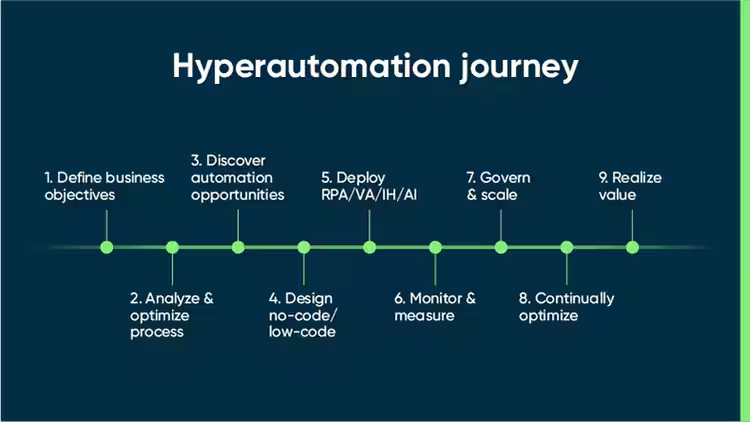
Automation has existed in ServiceNow for a long time. Most organizations using ServiceNow have implemented workflows, approvals, notifications, and basic flows. But as organizations expand with layered processes and data spread across multiple systems, simple automation becomes insufficient. This is where hyperautomation enters.
Hyperautomation in ServiceNow is more than a feature or a plugin. It represents a mindset — the belief that entire processes can be automated end-to-end using multiple technologies, rather than automating individual tasks. When properly executed, it transforms team dynamics, decision-making, and operational velocity.
What hyperautomation really means (beyond the hype)
Hyperautomation is automation at scale, but it encompasses much more. It centers on leveraging multiple automation capabilities to make most processes human-independent.
Core components include:
- Workflow automation
- Flow Designer
- IntegrationHub
- RPA (Robotic Process Automation)
- AI and machine intelligence
- Decision logic
- Analytics and reporting
Rather than asking “Can this task be automated?” hyperautomation asks “Why does this task need to occur at all, and how can the entire process unfold autonomously?”
Why organizations are turning to hyperautomation
Organizations often face not a shortage of tools but siloed approaches. Different departments use email, spreadsheets, ServiceNow, or isolated systems that require extensive manual integration.
Common problems it addresses:
- Excessive handoffs between teams
- Delays from approvals and validations
- Information access that requires human intervention
- Internal inconsistencies
- High operational costs
Enabling hyperautomation through ServiceNow
ServiceNow isn’t a single hyperautomation solution but rather an integrated environment where multiple capabilities work seamlessly together.
Flow Designer as a foundation
Flow Designer is the entry point for hyperautomation initiatives, enabling teams to make intelligent decisions with minimal coding. Unlike standard automation, flows can:
- Trigger activities
- Pull information from multiple systems
- Dynamically apply business rules
- Make autonomous decisions
Flows become intelligent pathways rather than linear sequences.
IntegrationHub: connecting the enterprise
Hyperautomation fails if ServiceNow operates in isolation. IntegrationHub enables ServiceNow to communicate with HR systems, finance tools, cloud platforms, identity providers, and monitoring solutions. Rather than replicating data manually, the system automatically retrieves, updates, and syncs information across the enterprise.
RPA: automating the non-API gap
Not all systems have clean APIs, and legacy systems often require human interaction. ServiceNow RPA addresses this limitation. RPA bots can:
- Log into legacy systems
- Click buttons
- Extract data
- Submit forms
These bots function as virtual employees, operating 24/7 based on predefined rules and filling automation gaps previously thought impossible.
AI: enabling smarter automation
ServiceNow AI enhances automation beyond speed, enabling smarter decision-making through complex data analysis and recommendations:
- Predicting ticket types
- Suggesting resolutions
- Anomaly detection
- Intelligent routing
Unlike hard-coded policies, this automation learns from patterns and historical trends, improving continuously without manual rule adjustments.
A real-world example: employee onboarding
Without hyperautomation: HR creates an entry, IT receives the request, access is requested manually, hardware is ordered via email, and facilities are notified sequentially.
With hyperautomation in ServiceNow: the HR system automatically triggers onboarding, ServiceNow assigns department-to-department tasks, integrations provision access automatically, RPA handles legacy systems, and role-based approvals occur automatically. The new employee is productive on day one — with no follow-ups, emails, or delays.
Benefits that go beyond speed
- Higher consistency: processes operate identically each time, minimizing errors and variation.
- Improved compliance: regulations are automatically enforced, simplifying audits and security.
- Quicker decision-making: data analysis happens in real time rather than retrospectively.
- Reduced operating costs: less manual labor means fewer resources spent on redundant tasks.
- Happier teams: people engage with meaningful work instead of mundane tasks.
Challenges to watch out for
- Over-automating poorly designed processes
- Lack of clear ownership
- Poor data quality
- Team resistance to change
- Inadequate governance
Automation should follow process clarity, not substitute for it. An automated faulty process is simply a faster faulty process.
Final thoughts
ServiceNow hyperautomation doesn’t eliminate human involvement; it eliminates operational friction. When automated systems handle repetitive work, humans focus on strategic thinking and problem-solving. Successful organizations view hyperautomation not as isolated functionality but as an operating model. In an environment where speed, accuracy, and adaptability determine success, hyperautomation is essential rather than optional.