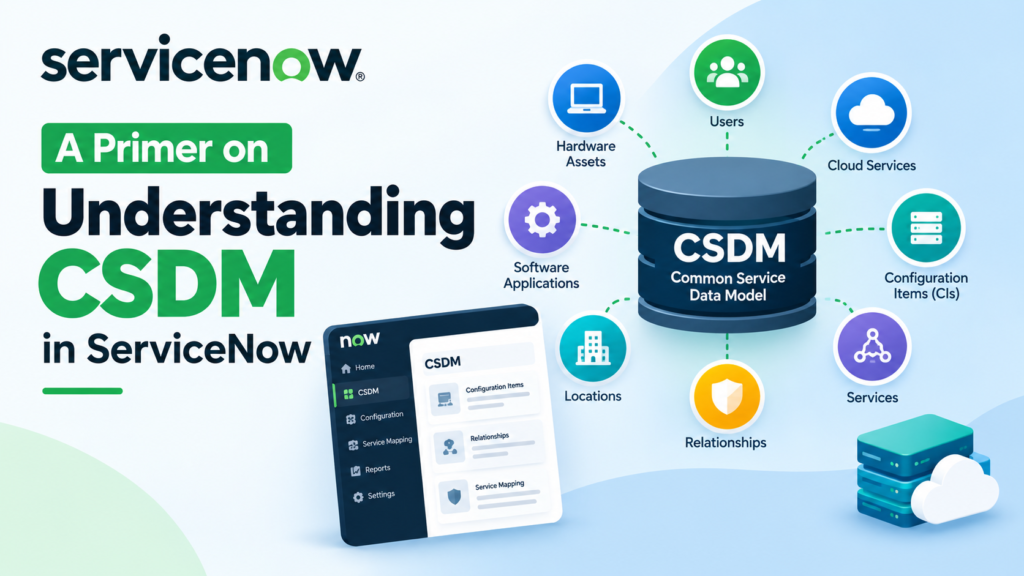
A Primer on Understanding CSDM in ServiceNow: The Framework that Brings Order to the CMDB
If you’re like many customers of ServiceNow’s Configuration Management Database (CMDB), you’ve probably experienced the same element: matters start well-organized, however over the years, things begin to get messy. Different groups in the organisation are using the CMDB in specific approaches, and the CMDB starts to become less beneficial and more puzzling.
That is the hassle that the commonplace provider information model (CSDM) solves.
CSDM isn’t always just some other buzzword that IT humans want to throw around. alternatively, it’s a framework that helps agencies like yours powerfully arrange their CMDBs. In place of having each crew within the organization do their own factor when it comes to modeling their offerings and applications, the CSDM framework helps hold everything aligned.
At its core, the CSDM framework is a solution to the easy but essential question:
How will we arrange our service statistics so that everyone inside the agency is familiar with it in an equal manner?
Why ServiceNow added CSDM
Before the introduction of CSDM, most corporations confronted a situation in which the layout of the CMDB become now not constant. One-of-a-kind organizations might have an extraordinary view of what a career is. Some might be centered on infrastructure, others could be targeted on packages, and the commercial enterprise service might be modeled one by one.
What this is supposed changed into that quite a few facts are technically contained inside the CMDB, but no longer necessarily in a manner that becomes effortlessly understandable.
As an example:
- The infrastructure crew ought to have an excellent view of the servers and databases.
- The software group may want to have an excellent view of the components of the applications.
- The commercial enterprise group could have a great view of the offerings; however, it no longer necessarily needs to be well-connected to the technology.
While an incident befell, it was no longer always smooth to understand what was going on.
- What software changed to offer the carrier?
- What infrastructure was affected in an outage?
- Who turned out to be in the end answerable for the provider?
CSDM was evolved to address those troubles. It became advanced to be a standardized shape wherein generation services, enterprise services, and infrastructure can be easily connected.
The primary concept behind CSDM
Rather than permitting every organization to have a one-of-a-kind layout for the CMDB, the CSDM provides a brand new level of abstraction. Each degree represents a unique angle on how services operate within the company.
The framework gives solutions to the subsequent questions:
- What services does the enterprise offer?
- What packages offer the services?
- What infrastructure presents the programs?
- Who owns the exclusive portions?
- How do the extraordinary pieces of the organization operate collectively?
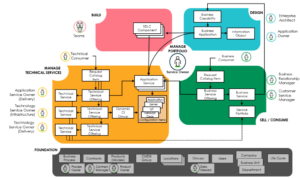
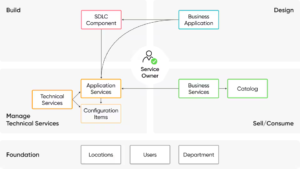
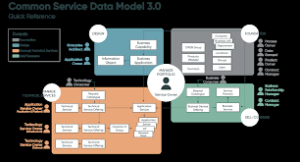
The 4 Key Domains of CSDM
The not-unusual carrier statistics version gives numerous domains of carrier information. These statistics present a manner of knowledge of how extraordinary portions of the company’s IT environment operate collectively.
1. Layout area
The layout domain affords a manner of know-how for the planning and definition of offerings before they’re carried out. That is the level at which service architects and architects of the service platform define the structure of the offerings and the applications.
This level of the layout domain provides the following:
- commercial enterprise competencies
- facts objects
- utility offerings design
- Technical service design
The design domain answers the subsequent query:
How will this service be designed?
2. Manipulate Technical Offerings domain
This domain is concerned with the generation that simply supports the applications. The technology consists of infrastructure, including servers, databases, and cloud technology.
On this layer, technical offerings are controlled to preserve the structure’s walking.
Examples:
- Database services
- network services
- website hosting offerings
- garage services
That is the vicinity within the CMDB that infrastructure groups generally tend to spend maximum time in.
3. Promote and eat area
The promote and devour domain is the location that ties era with enterprise. It’s miles worried with the offerings which might be honestly used or fed on through the commercial enterprise or the customer.
Examples:
- patron-dealing with services
- inner commercial enterprise services
- provider catalog
That is the place inside the CMDB wherein IT offerings are provided to the consumer in a manner that is significant from an enterprise angle.
4. Control Portfolio domain
This domain is all about dealing with the packages with regard to the overall portfolio of the corporation. right here, you could locate information concerning the utility ownership, application lifecycle control, and alertness governance.
Some of the information that may be tracked at this stage includes:
- application lifecycle tiers
- accountable teams or utility proprietors
- Strategic significance of the software
This level is beneficial in supporting the management to recognize the criticality of the software and when the utility is probably to be retired from the employer’s machine.
How CSDM Improves CMDB Clarity
CSDM is quite beneficial in the creation of clear relationships between the business offerings, the software services, and the technical offerings within the business enterprise.
For instance, when the net price gadget in a given corporation fails, the IT team might not be in a position to identify the exact purpose of the failure without the right CMDB shape.
But, with the CSDM approach, the exact relationship is clear as follows:
- enterprise service
- application service
- Technical carrier
- Infrastructure
Consequently, in case of any hassle in the system, the IT team can easily perceive the source of the hassle and address the problem accordingly.
That is quite beneficial during the trade control and the incident control approaches.
Why organizations undertake CSDM
There are various reasons why a business enterprise could enforce the CSDM framework.
- The first motive is that the framework encourages group collaboration. The infrastructure crew, utility group, and carrier crew are able to work together using the equal framework, eliminating any form of bewilderment.
- The second motive is that the framework enhances reporting and visibility. The reporting of the fitness of the carrier, provider outages, and service dependencies makes extra sense while the carrier is modeled effectively.
- The third motive is that the framework encourages knowledgeable choice-making. The company is able to see the dependencies that the enterprise carrier has at the utility and infrastructure layers.
- Lastly, the framework helps a corporation scale its ServiceNow example. As the enterprise expands, and other systems are introduced into the surroundings, the framework ensures that the CMDB is nicely prepared and no longer chaotic.
The function of CSDM in present day service control
ServiceNow still actively promotes CSDM as an underlying idea for lots of its packages.
For example:
- ITSM
- ITOM
- service mapping applications
These rely heavily on properly-based information within the CMDB.
If an employer does not have a service version in place, it is almost not possible to automate. For example, an organization might use software that video display units the health of services on video display units.
CSDM gives an enterprise exactly that.
It ensures that a business enterprise’s automation equipment recognizes how the various parts of the company relate to each other, as well as how incidents may have an effect on an organization’s offerings.
Getting commenced with CSDM
Adopting the ideas of CSDM does not always mean that an organisation has to recreate an existing CMDB. That is because most agencies do not.
In reality, most groups that undertake CSDM do it gradually.
For example:
- A corporation would possibly first discover key commercial enterprise services.
- Then relate them to the programs that support them.
- From there, infrastructure components may then be associated with the best technical services.
Over time, the carrier version will become more detailed.
Final thoughts
Whilst the commonplace service facts model may additionally appear at first glance to be simply another framework, the impact of the common provider records version on ServiceNow implementations may be extensive.
By means of supplying a fashionable technique for modeling offerings, packages, and infrastructure, the not unusual service information version can transform the function of the CMDB from being honestly a data repository into a powerful tool for understanding how technology supports the business.
For lots of organizations that have implemented the commonplace service records model, the result is a ServiceNow environment that is easier to manage, in which incidents are resolved much faster and where the relationships between offerings are much cleaner.
For a platform, this is all about connecting human beings, methods, and technology. The distinction that the not unusual service data model can make in terms of presenting readability and supporting the organisation’s transition from disparate facts toward a more connected provider environment can not be overstated.