CI relationship types in ServiceNow – knowledge of the Connections That Make the CMDB useful
When you first start working with the CMDB in ServiceNow, maximum of the focal point clearly falls on the Configuration items themselves.
- Servers
- Packages
- Databases
- Community gadgets
it makes sense. Those are the actual things you’re trying to control.
But after working with the CMDB for a little while, something is lacking.
You may see all the Configuration gadgets.
But you don’t truly recognize how they’re related to each other.
And without this, the CMDB is really just a listing.
That is where CI relationships are available.
Relationships aren’t usually easy to recognize, and they don’t always get the attention they deserve. But when you start working with them effectively, the CMDB is no longer just statistics; it’s a living map of your complete IT surroundings.
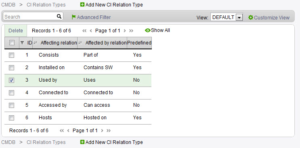
What are CI Relationships, definitely?
A CI courting is, at its best, the relationship among configuration items. But it isn’t simply the connection between configuration gadgets. It’s miles the definition of the relationship between two configuration objects.
for instance:
- A web application is probably running on a server.
- A server is probably going for walks on a virtual system.
- A database is probably used by software.
Those relationships are not arbitrary. They’re associated with the sort.
Without the sort, you most effectively know that the two configuration objects are associated.
With the type, you know the way the 2 configuration objects are related.
This is the critical component.
Why courting kinds count more than you suspect
CI relationships can be easy to miss. They may be visible as unimportant. Many humans’ cognizance of populating the CMDB. They forget to worry about the connection sorts.
But this is a mistake.
It can cause issues:
- It can cause you to not know which offerings are probably impacted during an outage.
- It can cause you to begin to bet.
They help you in answering questions, including:
- What programs will be impacted if this server goes down?
- What offerings depend on this database?
- What infrastructure is helping this enterprise service?
Without relationships, these answers aren’t without problems discoverable.
With relationships, they’re only a few clicks away.
Commonplace kinds of CI Relationships in ServiceNow
ServiceNow gives a selection of predefined relationship sorts. You do not have to create the whole lot from scratch.
A number of the most commonly used ones are:
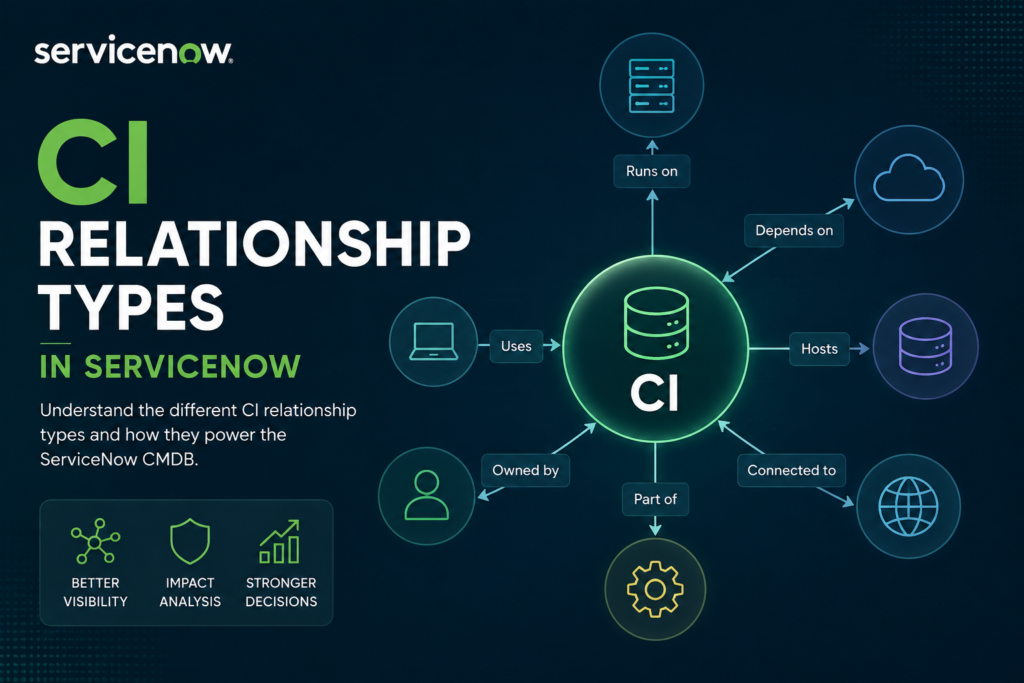
Runs on / Runs
This might be the most acquainted one.
It truly depicts where the software is going.
instance:
- A software is running on an application server.
Relies upon / Used by
This courting kind depicts dependency.
instance:
- An application relies upon a database.
- Or the database is used by the application.
Hosted on / Hosts
This time period is more often used in a digital environment.
example:
- A virtual gadget is hosted on a physical server.
Related to
This time period is ordinarily used to outline relationships in a network.
instance:
- A server is attached to a transfer or a router.
A part of / Contains
This term is ordinarily used to define hierarchical relationships.
example:
- A server can be part of a cluster.
The route of a courtship is also critical.
This relies upon the way you outline the figure and infant CI.
Understanding course – A Small element that modifies everything
One factor that frequently confuses human beings, specifically while they’re new to IT, is the path of a courting.
instance:
- “Utility runs on the server.”
- “Server hosts application”
Each of those statements outlines a relationship; they define it from exclusive instructions.
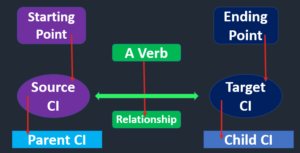
In ServiceNow, a relationship has three houses:
- A parent CI
- A toddler CI
- A dating kind
In case you get those 3 properties incorrect:
- nothing will ruin
- But you may get burdened consequences when you run a file
- Take a look at a dependency graph
- Or carry out an impact analysis
It might not be a massive deal, but it’s miles worth listening to.
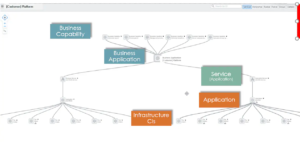
Wherein you absolutely see these Relationships
In case you’ve ever opened a CI record and checked out:
- The related objects
- Or Dependency View
Then you’ve already seen those relationships in motion.
The Dependency View, especially, is in which everything comes together visually.
You notice how a CI is hooked up to other CI objects in a series.
It’s at this level that the CMDB stops being only a collection of statistics and becomes a map.
You may see how a failure in a single CI can propagate through the machine.
And touch a couple of services.
This is why organizations go through the trouble of constructing the right CMDB.
Actual-world instance: Why Relationships Matter
permit’s say a database server is going down.
without relationships:
- This server is down.
- But you can no longer understand which programs are using this server.
With relationships in the region:
- You immediately understand which programs are using this database server.
- You fast identify which business services are using this database server.
- You notify these offerings, decreasing downtime.
This is wherein CI relationships shine, not in concept, but in exercise.
A few nice Practices in CI Relationships management
You’ll observe, over the years, that handling relationships is just as vital as building them.
a few pointers:
- Maintain it simple
- No need to invent new courting types unnecessarily
- Use fashionable ones every time possible
- Be steady
- If one team defines a dating kind as “runs on.”
- And any other group defines a custom dating type for the same purpose
- Your CMDB becomes inconsistent
- consciousness of meaningful relationships
- No longer are all relationships worth monitoring
- Outline meaningful relationships
- folks who add a fee to reporting, troubleshooting, or effect analysis
- Validate often
- Relationships emerge as invalid over time due to infrastructure modifications
- Periodically validating relationships will keep your CMDB accurate
- As is normally visible, nearly talking
- Automate wherein viable
- Automate relationship control and the usage of the discovery gear whenever viable
- similar to manual upkeep
- In most cases
The Hidden Price of CI Relationships
What is the value of CI relationships?
- It isn’t always the relationship
- It’s far from the context it gives
As is typically visible:
- It’s miles the structure it creates with the statistics
- It is the capacity to apprehend the dependency among distinct groups
- without having to understand the technology behind the distinct components
In easy phrases:
- It is the ability to make knowledgeable selections
As usually seen:
- In trade control
- Incident decision
- chance assessment
The relationship provides the whole photo.
Conclusion
CI relationship sorts in ServiceNow might appear to be a characteristic that isn’t always really crucial, but it’s clearly one of the most critical aspects of a well-maintained CMDB.
It is the readability it provides to the complex international world we live in
When you start using it efficaciously, everything is less complicated to comprehend:
- It’s far less complicated to recognize the exclusive connections
- The special dangers
- And the one-of-a-kind influences on the surroundings
in lots of ways:
- The configuration items are the pieces
- Relationships are the pieces to the puzzle
- And the puzzle is the configuration of objects