But what springs to mind, and what people typically think of when they hear the “CRM,” are things like sales funnels, follow-ups, and data-rich screens filled with numbers. But what they are seeing is only half of what needs to be seen, because, in real-world organizations, the relationship management aspect of CRM doesn’t sit solely within sales groups. All of that includes what CRM is doing behind the scenes at ServiceNow.
The ServiceNow CRM isn’t simply a replacement for more traditional CRMs and lead tracking solutions because, quite simply, “it’s all about linking customer engagement directly with the systems that actually fix things, provide services, and keep promises.” Customer data isn’t simply stored in a vacuum, as with most CRMs, but within an operational environment.
This is what makes CRM in ServiceNow unique and, in all honesty, more applicable for companies that handle genuine customers and genuine problems every day.
CRM in the New ServiceNow Universe
What CRM Means
A ServiceNow CRM emphasizes handling interactions between customers and services, support, and operations rather than dealing with sales-related interactions. The approach brings:
- Customers
- Accounts
- Cases
- Orders
- Communications
under one umbrella that has knowledge of workflows, automation, and governance.
Rather than “What did we sell to this customer?” ServiceNow CRM asks:
- What are they going through?
- What services are they using?
- What are our undertakings to them?
- Are we resolving their calls for help as efficiently as possible?
The reason this new paradigm of thinking makes a difference is the fact that the overall satisfaction of the customer relies more upon the delivery of the services than the initial conversations for the purchase of the product.
Choosing ServiceNow for Your Business Needs
In most cases, such institutions will be using ServiceNow for:
- IT
- Human resource services
- Security operations
The most sensible addition would be customer relationship management because that will eliminate silos.
Here is an explanation of how things are different when CRM is based on ServiceNow:
- Client requests will be processed like a business service, not a free-floating email or spreadsheet.
- Customer cases can be triggered for approvals, tasks, SLAs, and escalations.
- Support teams have the entire context of the customer, not just the ticket number.
- Sales, service, and business operations can finally share common data.
- Rather than toggling between systems, the teams remain within one system that maintains accountability.
The Essential Components of CRM Systems on ServiceNow
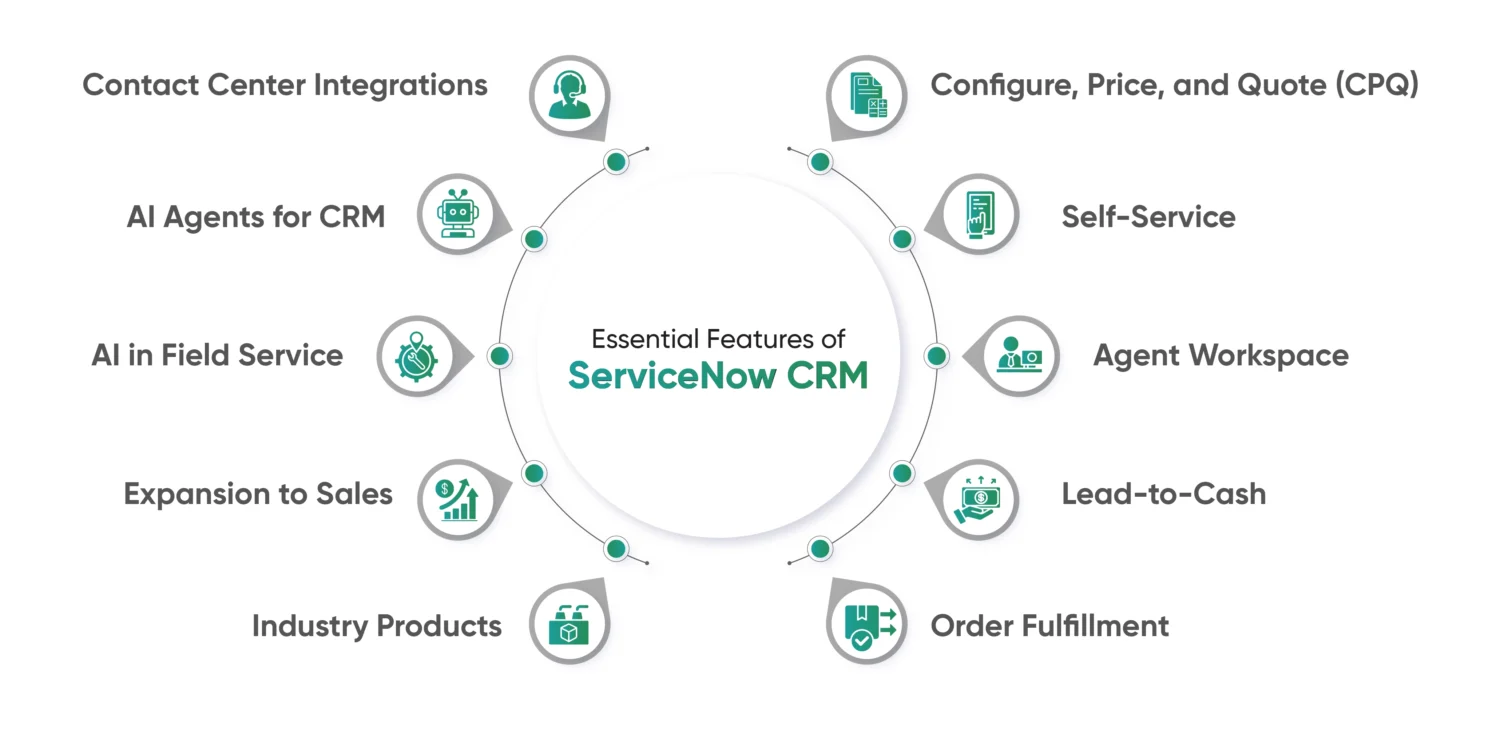
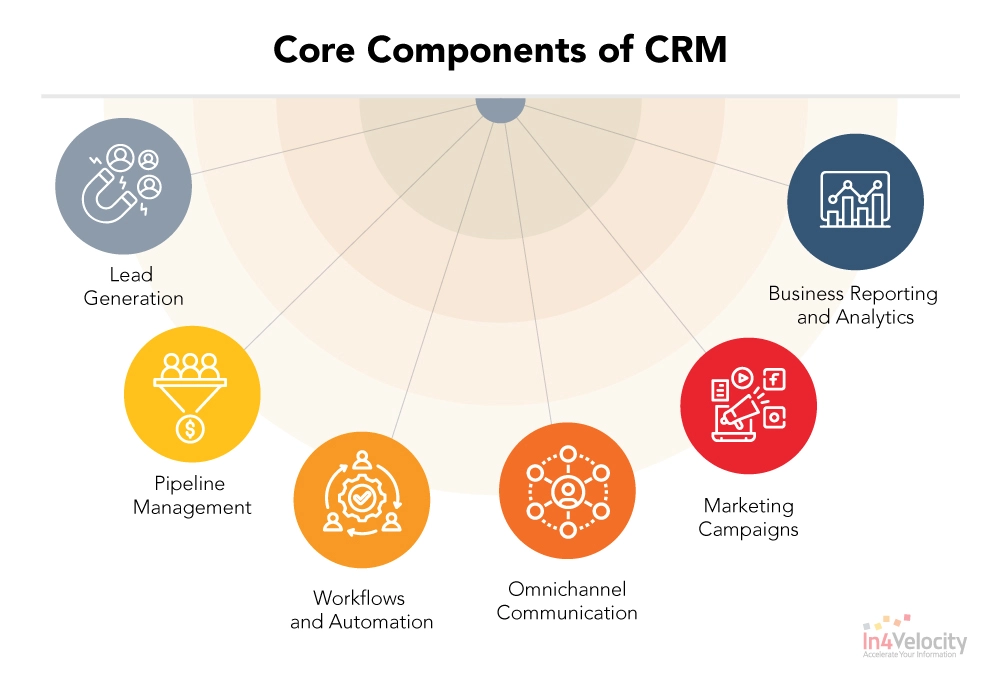
The ServiceNow CRM solution is based on a combination of a few essential components.
Customer Accounts and Contacts
ServiceNow maintains stored information about customer businesses and corresponding contact information in structured tables. These tables are associated with:
- Cases
- Orders
- Contracts
- Incidents
This means every incident is traced back to an actual customer.
Customer Service Management (CSM)
CSM or Customer Service Management is the core of ServiceNow CRM. It helps clients submit their problems, requests, or just inquiries through:
- Portals
- Emails
- Integrations
Every case has a life cycle. There are:
- SLAs
- Priorities
- Assignments
Case Management
Customer cases would work like incidents, but are for external users. They contain:
- All the communications history
- Internal notes
- Attachments
- Steps to resolution
all in one place.
Product and Service Awareness
Cases can be related to specific products or services, facilitating the identification of recurring problems by the teams in performance gaps and training needs.
The True Power: CRM + Workflow
It’s in workflow automation where ServiceNow CRM really separates itself from traditional CRM tools.
When there is an issue, ServiceNow doesn’t just raise a ticket; it reacts.
- Tasks can be created automatically for the fulfillment teams.
- Approvals can be routed to the managers or finance.
- Notifications can be sent to customers at every stage.
SLA can track the response and resolution times. Escalations can be triggered when commitments are at risk. All this without follow-ups, without constant supervision: the system enforces the process, not the people.
What Does This Re-Engineering Mean?
Picture this: there is a telecom operator using ServiceNow CRM.
- A corporate customer has reported an outage using its customer portal.
- That is a customer case.
- This case is directly associated with the customer account and active service contract.
- An internal incident is created for the network team.
- An SLA begins its countdown based on the customer’s agreement.
The customer gets status updates without having to call the customer service team multiple times.
Before the case is concluded, everything that happened is recorded.
- There are no lost emails.
- There is no unclear accountability.
- There is no need to manually trace.
This CRM goes beyond keeping track of talk; this CRM supports the business.
CRM and Integration Across The Enterprise
Also, ServiceNow CRM does not work independently; rather, there is natural integration with other modules of ServiceNow.
- ITSM integration enables technical problems to automatically feed into IT operations.
- HR Integration: This feature is used for the management of customer access and access requests.
- Asset and CMDB integration relates customer issues to the actual infrastructure.
- It assists in the management of customers’ reported security issues.
This networked method can eliminate delays as well as the handoff associated with traditional approaches, which always disappoint clients.
Reporting and Customer Visibility
A further key benefit of CRM within the ServiceNow application is the provision of reporting capabilities.
The reason why reporting gets so much more valuable is that the data about the customers is right within the same system as the workflows and the tasks.
You too could respond to such questions:
- Which customers file the most cases?
- What sort of services attract the most complaints?
- How fast are we responding to high-value customers?
- Where do SLAs fail most often?
Teams overloaded:
These findings allow an organization to improve customer satisfaction, along with enhancing overall efficiency within an organization.
How CRM in ServiceNow Feels More “Real”
The customer relationship management
A more traditional CRM usually involves extensive data entry. Users are often occupied with updating fields, which does not solve problems. This results in outdated and inaccurate data being stored.
One thing that stands out in the case of ServiceNow CRM is its
- Records are updated while the work is carried out and not as an additional task.
- Cases proceed because tasks proceed.
- Statuses vary since workflows.
- Customer updates occur because the system forces communication.
This makes it more natural and less resistant from a team perspective.
Challenges to Keep in Mind
Like all powerful tools, ServiceNow CRM has to be carefully designed.
- Ineffective business processes will hinder team productivity.
- Too many custom fields may lead to cluttered records.
- Lack of clarity on who owns the case can cause confusion in
The trick here is that these processes have to model how business is done, not on paper but as it actually happens.
Conclusion and Recommendation
ServiceNow’s CRM, for instance, does not solely relate to the management of customers. It also deals with the management of customer experiences via properly organized operations. ServiceNow, therefore, presents an ideal and scalable working environment for a CRM.
For those organizations already using ServiceNow, CRM is simply the next step. It does not introduce additional complexity or another application to manage. It integrates customers with the departments they interact with, replacing assumptions with clarity. Once it is implemented in the correct manner, the CRM system in the ServiceNow application removes the aspect of ‘just another system’ and becomes the ‘spine of customer relationship management’ in the business.