
ServiceNow App Engine: Where Business Ideas Become Real Workflows
In every organization, there’s a hidden treasure: great ideas that never get built.
They come from employees who see bottlenecks in processes, from managers who know the pain of manual work, and from departments tired of chasing approvals through email chains.
The challenge? Those ideas rarely make it to production because building apps often means waiting in the IT queue for months.
This is where ServiceNow App Engine flips the script. It takes the Now Platform’s core strengths and gives anyone with a process problem—not just developers—the ability to turn ideas into working apps faster than ever.
But let’s go beyond the usual “low-code” marketing pitch and look at why App Engine is becoming a game-changer for modern businesses.
The Transition from “IT-Owned” to “Business-Enabled”
Traditionally, business teams submit requirements, wait for IT to interpret them, and then review the app weeks or months later. That approach worked when technology changes were slower.
Today, speed matters more than ever. Markets shift, customer expectations rise, and compliance requirements evolve at lightning speed.
App Engine allows business users to take control—not by bypassing IT, but by partnering with it. With low-code and no-code tools, teams can:
- Prototype solutions in hours, not weeks.
- Collaborate in real time with IT to ensure security and scalability.
- Continuously refine workflows as needs change.
The True Power: Developing an App from an Idea Without Losing Steam
Most tools stop at “idea capture,” leaving teams dependent on long development cycles.
App Engine bridges the gap between ideas and execution by combining:
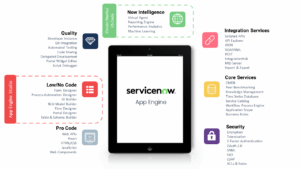
- App Engine Studio – A guided, intuitive workspace for building apps.
- Reusable Components – Prebuilt templates, UI pieces, and data models.
- Integration Hub – Easy connection to other systems without heavy coding.
- Automation Capabilities – Flow Designer for visual workflow creation.
Instead of starting from a blank screen, you start from momentum.
HR Onboarding as a Basic Example
Let’s say your HR team is drowning in emails from new hires, IT, payroll, and facilities whenever someone joins the company.
With App Engine, HR can:
- Use a prebuilt onboarding template.
- Add custom fields for role-specific equipment.
- Set up automated tasks for IT (laptop setup), facilities (desk assignment), and finance (benefit enrollment).
- Trigger progress notifications to the new hire.
Result? What used to take days of back-and-forth now happens in a single, orchestrated flow—with no coding and minimal IT involvement.
Low Quality ≠ Low Code
Some fear low-code tools mean “quick and dirty” solutions. That’s not the case here.
App Engine apps:
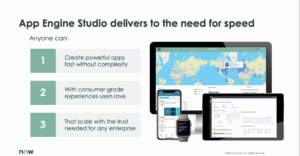
- Run on the same enterprise-grade Now Platform as ServiceNow’s own products.
- Benefit from built-in security, governance, and compliance controls.
- Can start small and scale to enterprise-wide deployments.
In other words, you get speed without sacrificing stability.
The Effect on Business
1. Speed to Value
The biggest win is time. An app idea can be validated, built, and deployed in weeks instead of quarters.
2. Empowered Employees
Departments no longer feel powerless waiting for IT—giving them ownership over their workflows.
3. Reduced Shadow IT
When business teams have a sanctioned, secure way to build apps, they’re less likely to turn to risky, unapproved tools.
4. Innovation Culture
When it’s easy to build, people experiment more—and innovation follows.
Freedom and Governance in Balance
Of course, with great power comes great responsibility. Without guardrails, low-code tools can lead to inconsistent apps and messy data.
ServiceNow handles this by:
- Allowing IT to set templates, data policies, and access controls.
- Providing role-based permissions to determine who can create, edit, and deploy.
- Integrating with the CMDB to ensure new apps fit into the bigger picture.
This fusion of governance and flexibility keeps both business teams and IT happy.
From “One-Off” Apps to an Interconnected Ecosystem
One overlooked strength of App Engine is how easily new apps connect with existing ServiceNow modules like ITSM, HRSD, and CSM.
Example:
If you build a vendor management app, it can:
- Create incidents if vendors miss SLAs (ITSM).
- Trigger security reviews (SecOps).
- Update asset records (ITAM).
Instead of being an isolated tool, it becomes part of a seamless digital ecosystem.
An Actual Success Story
A global logistics company used App Engine to replace their paper-based shipment damage reports.
- Before: Drivers filled out paper forms, scanned them, and emailed them to HQ. Processing could take a week.
- After: A mobile app built in App Engine lets drivers take photos, log details, and submit instantly.
- Impact: Processing time dropped from 7 days to under 12 hours, with full visibility for operations teams.
Advice for Making the Most of App Engine
- Start Small – Pick a process that’s painful but manageable for your first project.
- Engage Both IT and Business – The best apps come from collaboration.
- Leverage Templates – Don’t reinvent the wheel—build on proven designs.
- Think Reusable – Create components others can use in their apps.
- Review and Refine – Gather user feedback quickly and iterate.
Concluding remarks
ServiceNow App Engine is more than a development tool—it’s a bridge between business needs and technical delivery. It allows organizations to move faster, innovate more, and do it all without losing governance or quality.
In a business world where the next big opportunity could be one idea away, App Engine ensures that idea doesn’t get stuck in the queue—it gets built, tested, and in the hands of users when it matters most.
It’s not just about creating apps—it’s about creating momentum.

No comment