
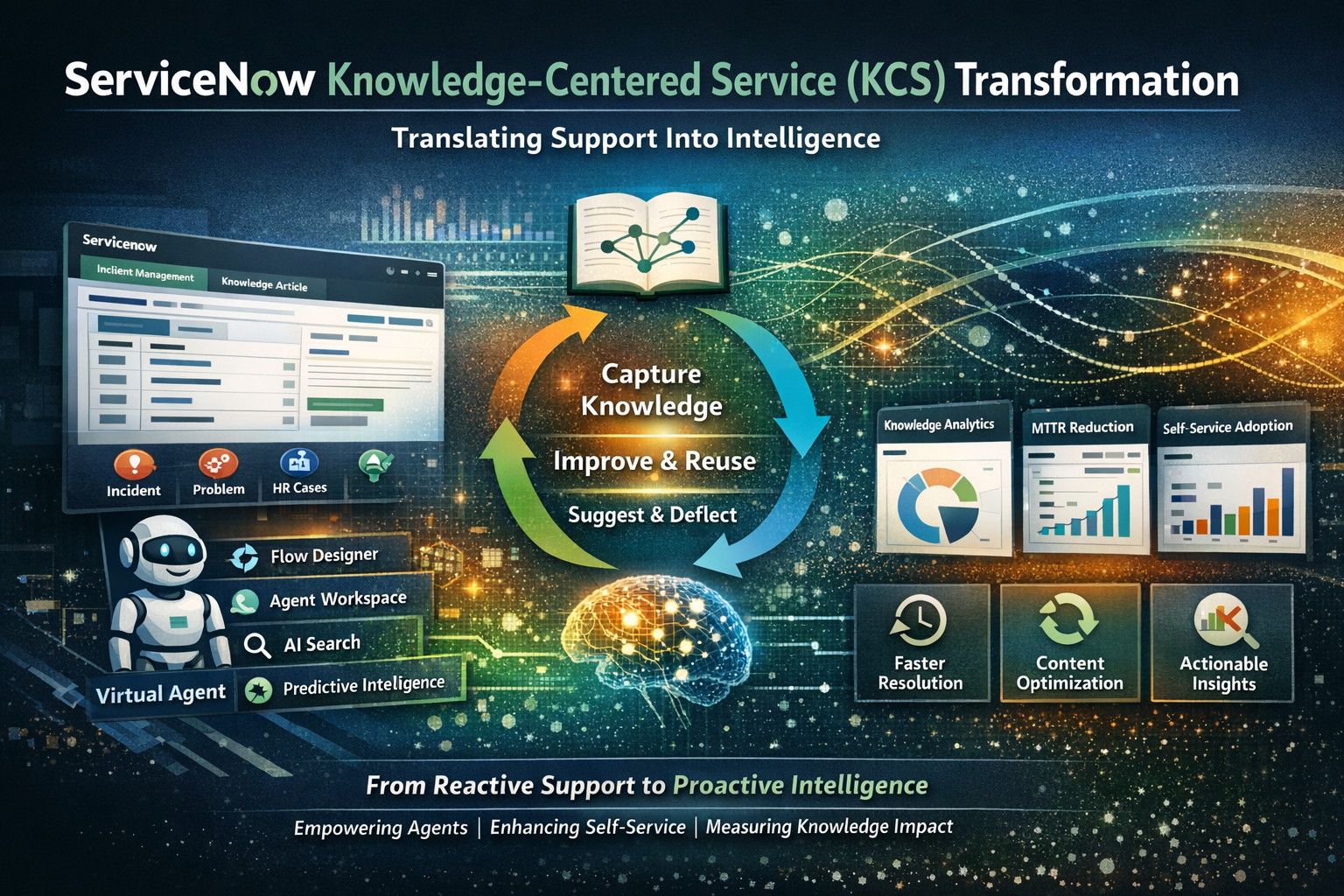
ServiceNow Knowledge-Centered Service (KCS) Transformation: Translating Support Into Intelligence
In most business environments, the support teams are always engaged. Tickets are coming in all the time, the same problems keep recurring, and the customer support staff are spending most of the day answering frequently asked questions. This can irritate the part of both the consumers and the customer support staff. But the problem isn’t a lack of effort—it’s the lack of a systematic way of learning and leveraging knowledge.
This is where Knowledge-Centered Service, or KCS, enters into play as a “game changer” that can radically change support when executed using ServiceNow.
KCS Beyond Documentation
Quite often, there is a misinterpretation of KCS as simply “copying into knowledge articles.” However, the truth is that KCS is actually a change in mindset. It is centered around documenting knowledge as an afterthought of issue resolution and not as an additional activity to be performed at the end of the day.
Traditional systems of support function in the following way:
- A problem arises
- A ticket is resolved.
- The knowledge vanishes together with the agent.
KCS reverses that paradigm:
- An issue arises
- It is resolved
- The solution becomes collective organizational knowledge.
ServiceNow offers an ideal platform for this because knowledge is created right within the incident and case process workflows.
The Failure of Conventional Knowledge Bases
In Even in today’s world, every organization has, to one degree or another, a knowledge base, though it is never utilized to its fullest potential. The reasons to
- Articles are outdated
- The text is couched in complex vocabulary.
- Knowledge creation is differentiated from work.
- Agents are not rewarded for contributing.
It means that users tend to submit queries rather than look for answers, and help agents tend to depend on internal experience rather than shared information.
ServiceNow KCS has solved these problems by ensuring that knowledge is easily created, easily improved, and easily trusted.
Role of ServiceNow in KCS
ServiceNow
ServiceNow does not consider its knowledge base a static resource. It considers it a dynamic system that grows every time there is an interaction.
Knowledge Created in the Flow of Work
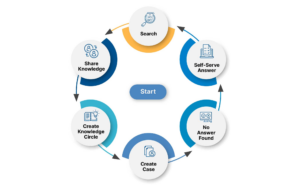
In ServiceNow, agents have the capability.
- Produce knowledge articles from incidents or cases.
- Establish connections between articles and solved problems
This will
- Update existing articles to solve problems.
This, in turn, eliminates the biggest hindrances in knowledge management, and those are extra efforts. Knowledge is now embedded within the workflow process.
1. Structured Yet Flexible Content
ServiceNow has structured templates, which allow for consistency with added flexibility. The articles include:
- Easy to read
- Focused on problem-solving
- Written in an easily understandable way
It is assured that the content is beneficial for both support personnel and consumers.
Continuous Improvement Rather Than a Single Effort of Writing
One of the most valuable attributes of KCS in ServiceNow is that of continuous improvement. The knowledge is never considered to be “finished.”
“noindex” follow.
“noindex” no
- User feedback can be automatically captured.
It is dynamic in the sense that the contents are changing depending on
This ensures that the knowledge base remains current. Furthermore, it keeps it accurate. Indeed, without this
Cultural Shift: From Ticket Solvers to Knowledge Contributors
Technology alone will not trigger the transformation in KCS. This transformation will begin the moment the teams abandon the ‘closing tickets’ mentality and start focusing on the development of collective intelligence.
ServiceNow enables this cultural transition by supporting:
1. Automation:
- Role-based permissions to create knowledge
- Role-based permissions
- Recognition for contributors
- Awards
- Knowledge Analytics for Monitoring Usage and Effectiveness
The agents learn to look upon the sharing of knowledge as some essence of their being, rather than a nicety.
The Effects on Support Teams
If KCS is implemented well using ServiceNow, it has an immediate effect on support organizations.
- The occurrence of recurring issues has reduced sharply.
- New agents learn and get on board faster.
- Dependence on senior personnel decreases.
- Confidence level increases
Rather than firefighting, teams can now work smarter. Knowledge becomes the first line of defense rather than the fallback.
Empowering Users with Self-Service
As for an individual’s perspective, transformation in KCS is even more powerful.
With ServiceNow:
- Knowledge articles are viewed during ticket creation.
- Users can resolve problems without needing support.
- The self-service portal becomes more effective at optimizing and
It thus creates a positive feedback mechanism. As users start discovering answers by themselves, there is a reduction in tickets, giving support staff more time to further enhance knowledge.
Measuring Success Beyond Ticket Numbers
Challenges in
Successful support has, traditionally, involved metrics such as ‘ticket resolution time’. KCS delivers smarter metrics, which are enabled through ServiceNow.
Organisations can monitor:
- Knowledge article utilization
- Customer self-service resolution rate
- Ticket deflection
- User satisfaction
================
These observations inform leaders not just how quickly issues are being resolved, but how effectively knowledge is removing future issues.
KCS as a Long-Term Strategy, Not a Project
Unfortunately, one of the biggest blunders that organizations commit is treating KCS as a short-term project, whereas it is actually a long-term strategy that an organization adopts.
ServiceNow assists in addressing this issue by:
- Sharing knowledge on an enterprise-wide scale
- The Integration of IT, HR, Customer Service, and Facilities Functions
- Building a single source of truth for the company
Knowledge, in the end, ceases to be the concern of a department and becomes corporate intelligence.
UTLBPARAPHEIN
THE
BIGGER
PICT
Essentially, the ServiceNow KCS transformation is the maintenance of experience. Every problem solved is a learning experience. KCS guarantees that learning will never be lost.
The organizations that implement this strategy transition from:
- Expertise: Individual Expertise -> Collective Intelligence
- Reactive Support → Proactive Service
- Information silos → shared understanding.
“ServiceNow does not merely hold knowledge – it links people, processes, and experience.”
The tools that ServiceNow provides comprise
Final Thoughts
Knowledge-Centered Service for ServiceNow
“Knowledge-Centered Service” for ServiceNow is not about writing better articles. It is about building a smarter organization where learning is a continuous, automatic process. When knowledge emerges in an intuitive way within the course of regular business activities, this directly leads to quicker support, empowered users, and more robust organizations. “In an information age that values speed, the true value lies not in the speed at which problems are solved but in the memory capacity for their solutions.”


 Transformation)
No comment