
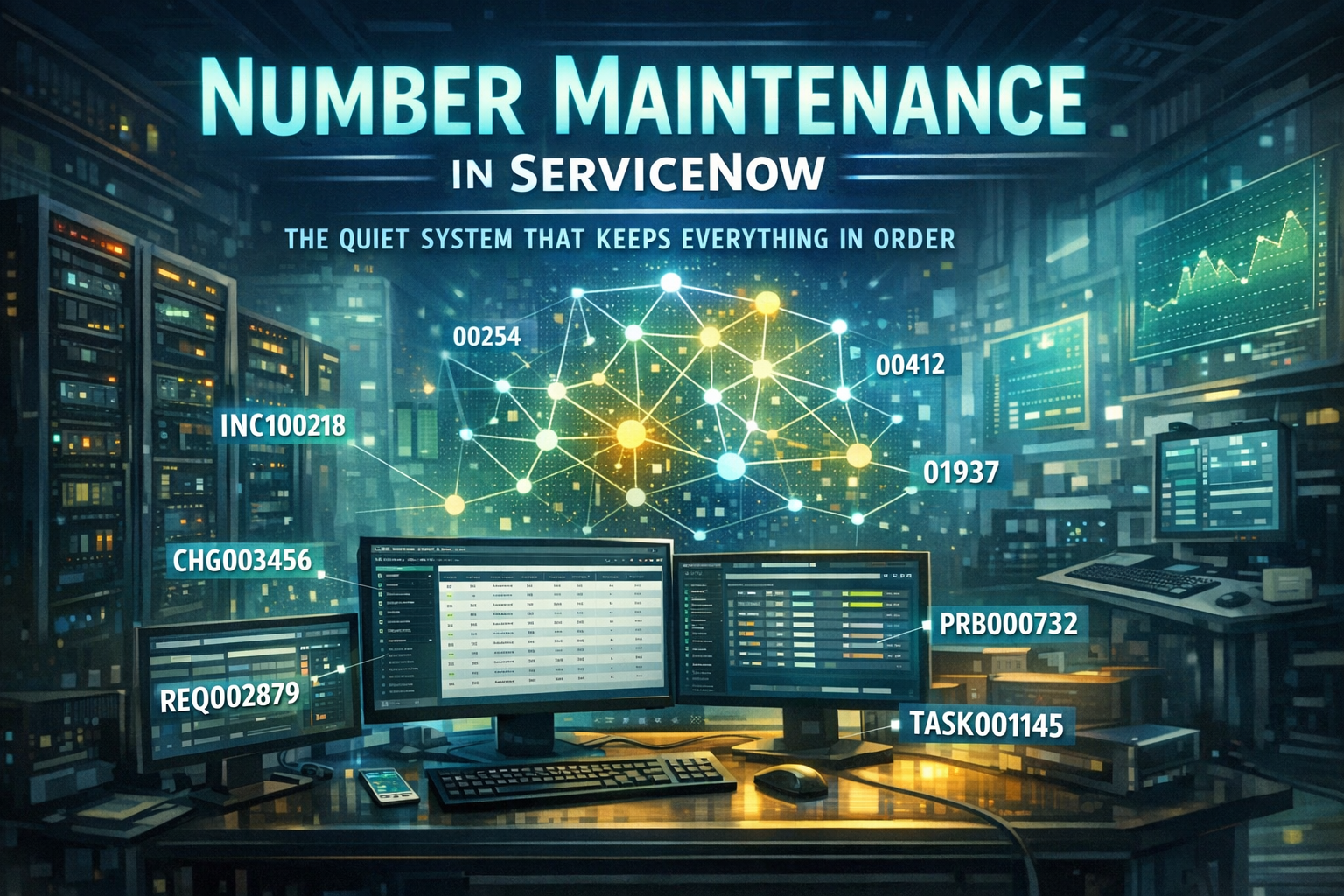
When people refer to ServiceNow customization, the conversations usually revolve around workflows, flows, integrations, or dashboards. Rarely does one stop to talk about numbering. Yet, numbering is among the first things users notice the moment they open the platform.
Incident numbers, change numbers, request numbers, problem numbers all of them quietly follow a sequence that feels reliable and predictable. That sense of order doesn’t happen by accident. It is handled by Number Maintenance, a small but extremely important part of ServiceNow that works silently in the background.
You probably don’t fiddle with it much, but if numbering goes wrong, everyone sees it.
What is Number Maintenance in ServiceNow?
Number Maintenance is the mechanism ServiceNow uses to generate unique, sequential identifiers for records. These identifiers help users track, search, reference, and communicate about these records without confusion.
Every time a record is created, a change request, or a record from a custom application, ServiceNow assigns it a number based on predefined rules.
For example:
- INC0001234
- CHG0005678
- RITM001245
Behind these simple-looking values lies a controlled system that ensures the following:
- No duplicates
- No conflicts
- No missing numbers
- Consistent formatting
That system is Number Maintenance.
Why Number Maintenance Exists
Picture a situation where the same event is assigned the same number by mistake, or where numbers just change randomly. This affects reporting, and the integration process would not work. Auditing would not even happen. Even communication itself would not go well.
It offers:
- One source of truth regarding record numbers
- Consistency in environments
- Control over how data/records are identified
- Control over data
- Integrations and third-party systems stability
Otherwise, ServiceNow would be a chaotic experience very soon.
Number Maintenance Process: Working Behind the Scenes
A typical number definition comprises:
- A Prefix (such as INC, CHG, or PR
- Starting number
- A minimum digit length
- An increment value
When a new record is created:
- ServiceNow checks the number definition for that table.
- It locks the number immediately.
*The initial designation is done for a specific reason. In this case
This occurs so quickly that a user never experiences the actual processing, just the result.
Where You Encounter Number Maintenance Every Day
Although you may not have entered the module called Number Maintenance before, you are interfacing with it every day.
You see it when:
- An event is recorded.
- A change request is made.
- The request item will be generated.
- A problem record is opened.
- An application is developed for a specific area, and
The number field is typically read-only because it is not intended for editing. That alone is indicative of its importance to data integrity.
Why Numbering Matters More Than You Think
Why Numbering Matters More
Data is more than a number. Volumes affect people and their work.
- Communication
For example, it would be:
“That printer problem from yesterday” becomes “INC0012345.”
- Reporting
Reports use identifiers to classify, filter, or monitor information.
- Integr
Usually, external tools refer to records on ServiceNow using numbers rather than sys_ids.
- Aud
Autoρdetectores require sequential, Traceable record Numbers.
- User Trust
When data is understandable and consistent in its presentation of numbers, users can trust the system more easily.
Customizing Number Maintenance
It becomes possible for an administrator to format numbers as they want, especially when it comes to the usage of custom formats.
You can:
- Change prefixes
- Change the number size
- Set initial values
- Define a sequence in each table
For instance, the personalized human resources application may include:
- HRC
- HRC
It is evident at first sight to which module the record pertains.
However, customizations have to be carried out effectively. A change in numbering conventions in a production environment can have repercussions unless properly planned.
Common Problems of Number Maintenance
It’s always a
Although the design of the cipher appears simple, errors always creep in, especially when a new implementation is
- Resetting Numbers in Production
Resetting the counter can cause duplicates. This will ruin trust and integrations.
- Using the Same Prefix for Multiple Tables
Such creates confusion where different types of records appear the same.
- Manual Editing of Number Fields
This should never be allowed to happen except for an extremely specific business need.
- Ignoring Environment Differences
DEV, TEST, and PROD may have separate numbering states, leading to tests that are confused.
- Overcomplicating the
Unreadable prefixes make the number harder to use.
Good numbering systems must be simple, readable, and consistent.
Number Maintenance and Performance
One concern that usually arises is that sequential numbering impacts performance. ServiceNow actually handles the locking of numbers very well.
So, the system:
- Closes only the number line
- Immediately releases it right after the assignment
- Prevents race conditions
Numbering remains stable and fast, even for high-volume environments.
That reliability is one reason why the system discourages custom numbering logic in scripts when Number Maintenance already exists for this purpose.
A Real-World Scenario
It happened during a rollout where a customer asked why their incident numbers suddenly jumped from INC009800 to INC015000. They were worried that the data was lost.
Nothing was missing.
The jump occurred because:
- Test entries were made and then deleted
- The numbers are never repeated
Gaps are to be expected rather than a problem.
“The fact is, this is an important concept. Number gaps are not necessarily errors. Number gaps occur naturally during the way the system enforces uniqueness.”
After the client understood this, his concern was removed.
Number Maintenance Management Best Practices
Based on real projects, a few simple practices go a long way:
- Establish numbering rules at the outset of the project.
- Avoid changing prefixes after go-live.
- Never reuse numbers
- Document Numbering Conventions
- Keep formats short and meaningful.
- Test numbering changes in non-production instances only.
These small steps prevent big problems later.
Why You Rarely Notice Number Maintenance (And That’s a Good Thing)
If you haven’t already, please
“The best systems are the ones you don’t have to think about.”
Number Maintenance goes about its work quietly:
- It doesn’t break
- It does not slow things down
- It doesn’t confuse users
If it works this well, it tends to blend in and become inconspicuous – which is where it should be.
Final Thoughts
Number Maintenance in ServiceNow may not be the most glamorous of work, but it sure is important. It brings order to data, clarity to users, and consistency to integrations.
As far as workflow is concerned, it is the engine of ServiceNow. The body would then be tables. The heartbeat would then be number maintenance.
When you learn to respect it and take care of it well, it will become the foundation that silently supports all the things you create on the platform.




No comment